Supersonic: The Creation Myth of Seattle
Book Review PRESENTATION FOR THE WOMEN’S UNIVERSITY CLUB FEB 25, 2026
Because Supersonic is about Seattle from 1856 until now, and the author makes a point whenever he talks about his book that there are so many new people here that don’t know much about the city, I want to tell you that I moved here in 1998, pre-GPS and Google. I didn’t want to be ignorant about the city. I have tried to learn about the city and the region in my off hours. I taught myself King County with the Thomas Guide, driving around at night in the rain, going to meetings of the Enological Society. They used to be the only outfit in town promoting wine education and started out meeting with the Mycological Society at the Mountaineers Club over on 3rd West in the 1970s. It’s hard to fathom when Tom Stockley published his book, Winery Trails of the PNW in 1977, there were eight wineries in Washington State. I learned a lot from those folks who then had 30 years of experience traveling our region for wine. This was my first opportunity to meet engineers from Boeing who were active in the Boeing Beer and Wine Club, who frequently gave presentations. That club spawned many wineries in our region. I have neighbors today who were past presidents and still brew twigs and fruit in their basement. One of my readers’ favorite characters in my romance novels is a retired Boeing engineer.
I was a docent at MOHAI for a few years when they moved to the Naval Reserve Armory at South Lake Union, so I enjoyed their training program on the history of Seattle. While not an expert, I have some knowledge of how the settlement grew. I was an Ambassador for Seattle at the Central Branch of the library for about ten years. My responsibilities were to help the homeless and the tourists navigate the city and its offerings. I visited many tourist attractions and had brochures and maps to help visitors find their next stop. In the beginning of my job helping the homeless, I had a raggedy two-sided piece of paper that listed the free services for the homeless, where to take a shower, do laundry, get a meal, possibly find a bed. By the time the pandemic closed down my free service, I had about a 100-page bound purple pamphlet of services. Enough about me.
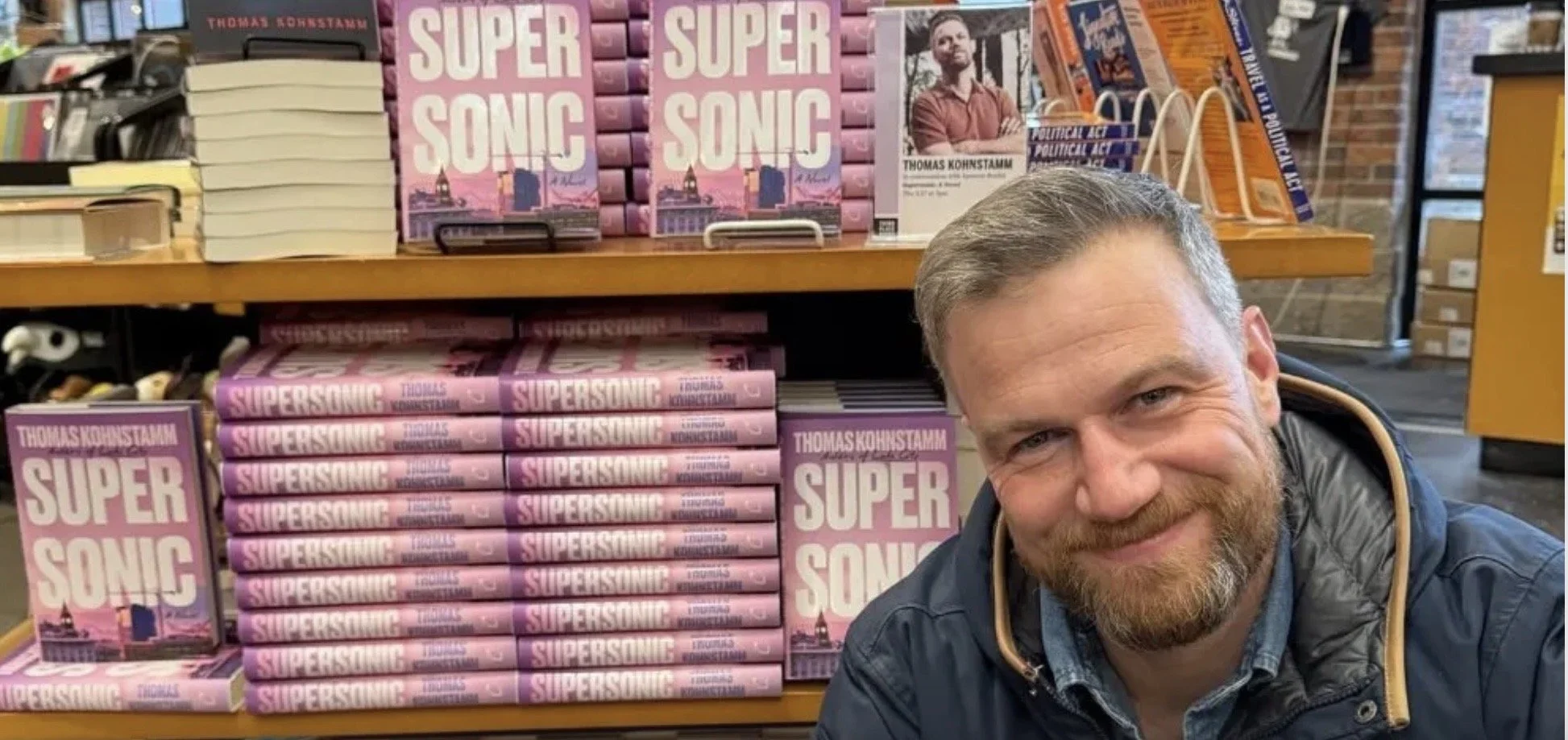
Let’s talk about Supersonic and Thomas Kohnstamm
When I read the review of this new fiction book by a local author in the Seattle Times one year ago, I immediately called the Queen Anne bookstore. I liked the way he described his idea:
“I don’t want to call it a history of Seattle,” he says. “I wanted to do more of an updated creation myth for the city. So many people that move here, they know about grunge or whatever. But it’s not a really well-defined place. It’s a young city on the edge of the world.”
He decided to tell about four families over 150+ years during three eras that were important to the development of the city we call Seattle today. The timeline changes about every five pages. This storytelling is not linear or straightforward. The three main eras he uses to frame the story are:
The 1850s Duwamish interaction with the Boston settlers.
The 1970s Boeing Bust.
The 2010s tech boom.
The author details the resources and people he used for research and the first readers of early drafts in the acknowledgments in the book. The Seattle Times review also mentions these people to substantiate the backbones of this story. For example, the Duwamish calling the white settlers Bostons is something the author learned from the local historian. History is tricky these days. There’s the current version of the victors as well as a few others. Kohnstamm wanted to juggle it honestly as he could to tell the story of all of his characters and never mention the names of the real people, companies, the word Seattle, or specific dates.
I enjoyed the book. He’s a great writer. He aimed high. He achieved a lot. I am impressed with the characters he created. They are nuanced, completely human. A few of them will stay with me for a long time. There are moments of laughing out loud. There are heartbreaking moments. There are some head-scratching moments where I decided to go back 10 pages to see if I missed something or Kohnstamm missed something. It was me. I think you’ll enjoy knowing a little bit about the author before we go further.
About the Author
Thomas Kohnstamm says, “I started my career as a travel writer, and I’m still writing about place in a lot of ways, and all the human elements that create place.”
I looked into that and learned that with his Master’s Degree from Columbia University in Latin American Studies, he started as a writer for the Lonely Planet. That’s a prestigious freelance gig. On an early project, it became apparent that he had created information in the guide as he’d already spent the advance money, according to some accounts, on sex, drugs, alcohol, and other things not related to his task. It’s also said that The Lonely Planet had to issue apologies, re-edit, and reprint the guide due to too many complaints about nonexistent or closed venues. Two important take-aways from this situation are that he published a memoir titled, Do Travel Writers Go to Hell?: A Swashbuckling Tale of High Adventures, Questionable Ethics, and Professional Hedonism (pub. in 2008). That was after he worked on the Lonely Planet guides to Brazil, Venezuela, and Colombia. Many of the readers found this book hilarious; a few were repulsed by the self-abusing travel writer; another said to take what you read in any travel guide with a grain of salt. Secondly, since then, he’s continued writing guides for the Lonely Planet on Argentina, Chile, Easter Island, and a Costa Rican Spanish Phrasebook & Dictionary. Mr. Kohnstamm is obviously as charming as his writing and is valued by the LP publisher. He has a powerful imagination. He is confident of his abilities.
The next book he wrote is called Lake City (pub. in 2019), which is the neighborhood he grew up in and continues to live in today in the same house he grew up in, now with his wife and children. The neighborhood is NE 95th to Shoreline. The tech boom that brought so much prosperity and glitz to Seattle did not come to Lake City. This is a grim story about an ‘incompetent aspirant’ who is home from graduate school in New York City, over the Christmas holidays, reeling from 9/11, estranged from his wife, immersed in the vices he loves: drugs, alcohol, dive bars, and depravity. When he’s not out and about in the neighborhood, he’s on the couch in his mother’s tv room ‘crying, drinking, and sleeping’. Some readers found it a slog, although I liked the one who called it Kerouac on the couch. I will read this book. I will drive around Lake City.
Kohnstamm’s day job is still freelance writing and making videos for corporations about tech stuff. He says, “I even make explainer videos about quantum computing,…I’m not a Luddite. But I am suspicious of this whole quantified life; data is true … this sort of tech religion.”
I think—I didn’t read this anywhere— that Thomas Kohnstamm carefully considered where his successful, lucrative writing future might possibly be found. He needed some likable characters, not himself, and a bigger story. I think he found it in the city of Seattle. As Kohnstamm says, “Being born and raised here, living in the same neighborhood, I’m like the resident senior.” It’s easy for me, Karen Tripson, to jump to a positive conclusion on who would be more qualified to update the creation myth of Seattle. If anyone else is thinking about it, Kohnstamm beat them to a publication date.
The Cast of Characters
Because the story jumps back and forth in time, from the 1850s, 1971, to 2014, a writer’s tactic to try to keep readers focusing, which I wish would go out of fashion, I’m going to tell you about the people in the story in chronological order.
Siab or old Indian Sam: in the early 1900s, he owned the hilltop farm with the big boulder, where he grew potatoes with his wife. He was the last Duwamish landowner, descended from headmen. He was a child called Little Chief when the Boston people in the 1850s murdered a lot of Duwamish.
Erasmus Stalworth: he never knew his mother, father, or his birthday, and became experienced in separating people from their money very early in life. As a kid in Creede, Colorado, he could panhandle, pickpocket, lead marks to fixed card games, and sell bogus raffle tickets. He sold newspapers, taught himself to read, and how to run a con. He assumed the name Erasmus Stalwart in Denver from a bankrupt land speculator. In Seattle at the beginning of the gold rush, he anointed himself the President of the Bureau of Information, told everyone he’d gone to Yale, and became a morphine addict. He created the slogan the Gateway to Alaska, which was a far-fetched notion to anyone who had looked at a map. The Chamber of Commerce in Seattle thought his grandest endeavor beyond his massive promotional campaign to get prospective gold miners to come to Seattle was the twist of words that made the Canadian suggestion of supplies for a year turned into a law where prospective miners had to have a Klondike kit purchased in Seattle. The kit was a literal ton of stuff reportedly essential to making it in Alaska that cost $1,000. He wanted old Sam’s farm and harassed him frequently, trying to make him sell it to him.
Masako Hasegawa: in 1971, she is a musician of string instruments, a teacher of music, the creator of the music program at Stevenson Elementary, and a survivor of two Japanese internment camps. She lives in a little house next to the big rock across the dirt parking lot from the school. This all used to be Indian Sam’s farm and then became Hasegawa Dairy Farm. She is the mother of Ruth, whom she wants to carry on as a musician and a teacher at Stevenson Elementary. Ruth causes her a great deal of aggravation with her failure to play an instrument well, her choices in music and people, particularly Larry, who is of unknown heritage but definitely not Japanese and seems to have been in trouble his whole life. Her husband is dead since the internment, and her only friend in 1958 is Archie Barrett, a janitor who rotates around the public schools buffing floors. Archie is a pianist. He is black, which becomes a problem for both of them. He plays music at church and at night around town with different bands. Already, he has played with Ray Charles, but Masako doesn’t know who that is. His family becomes active in the story in 2014. His son, Shawn, tries to help with the school, and his son’s daughter, Monica, is the music teacher at the school and is good friends with Sami, Masako’s granddaughter.
Ruth Hasegawa: is 25 years old in 1971 with an almost complete graduate degree in education. She is struggling with living with her strict mother, Masako, who wants her to marry a dentist whose family goes to the same church. Ruth wants to escape her mother and go anywhere with Larry. She hides her rock and roll records in her closet, which doesn’t fool her mother.
Larry Dugdale is descended from the Duwamish Sam, although everyone wonders if he’s white. He lives with his mother, never knew his father, and runs into trouble constantly, that are misunderstandings like being dishonorably discharged from the Navy. When the 1971 story opens, he has been employed by the big aviation company developing the Supersonic airplane for two years. His job machining valves on this amazing project that will change life on the planet will be his ticket to marry Ruth, whom he has loved since 8th grade, buy a house, and have a garden.
Sami Hasegawa-Stalworth is the daughter of Ruth and Larry and was raised by her grandmother Masako. In 2014, she’s been married to Percy Stalworth for 20 years and is the mother of four children, the eldest soon to go to college, the youngest still in elementary. She’s been the President of the PTA at Stevenson Elementary for a long time. Life is stressful with four kids who don’t do nearly enough to help her and fight her every step of the way about screen time and food choices. Her husband seems to be very busy. She promised her grandmother Masako before she died that she would get the school renamed after her and her excellent music program that’s inspired several world-class musicians. This has been Sami’s lifelong goal. Her sister-in-law, Kim, could help with this goal if she could get her attention. Kim and her husband are not interested in the arts. They think if anything changes, Stevenson should become a STEM incubator, not a STEAM school.
Percy Stalworth: Sami’s husband, is a good guy, husband, and father. He fell in love and married Sami because he admired her close family life that he never had. He commutes to his day job as a social worker at the high school by bike. He fills every extra hour devoted to his kids, exercising, and his two basement hobbies, which are brewing cider yeasts and designing a folding bicycle. He’s not rich like everyone assumes, as the Stalworth fortune was spent long ago. He does not want a private practice where he would make more money, as Sami wishes. He feels he’s doing the best by the kids by helping them in high school before their problems get bigger. They live in the small house by the big rock that belonged to Masako to compensate for their small income.
Kim Stalworth: is the VP of Giving for Mothership, a fictitious company that stands in for Microsoft and other tech companies in town, lives in a mansion on the water with her husband and son; she’s always in training or recovering from a triathlon. Her superpower is making people feel for a few minutes that they have her attention. Kim is running for mayor. Her right to be mayor was preordained by her great-grandfather Erasmus being a founding father of the city, and her own father being the mayor at one time.
Loose Bruce: ex-ski bum, ex-husband of Wren, ex-weed smuggler to Canada, father of 8-year-old Sierra, pot head, and pain pill popper for his back injury. He proudly wears at all times his 1996 Supersonics NBA Western Conference Champions hat, which smells very bad. He aspires to own the first shop to sell recently legalized marijuana. This is possible because he is an idea man. He’s always had lots of good ideas. He’s working hard on this. He thinks he’s found the perfect location, which is very complicated. This shop will solve all his problems and will make Wren love him again. He can go back to living with her and Sierra. Between the state of his mind and his decrepit 1987 VW Westfalia van, the Westy, Loose Bruce, always late, stumbles through all sorts of action and is comic relief except when someone like Sami really needs him to come through and on time to help her with the PTA activities. If only he could remember all his great ideas at the right time.
These are the key players in the story. Believe me, there are more. I don’t want to give any spoilers because I hope you all will want to read it. I’ll just provide a few key turning points.
The Action Begins with the Aftermath of a Massacre
A small group of Duwamish women and children work all night in 1856 dragging the dead bodies of their fathers and uncles up the wooded hill and storing them in a large pit they have dug and lined with sand and pebbles. The large boulder is pushed and pulled to roll down on top of the grave to seal it. The ground around it is carefully finished with twigs and branches to appear absolutely normal. They want to erase any signs of their activity and the site of the grave as it all needs to be intact when their creator comes back to restore order.
By 1897, this is still the farm of Siab, Old Indian Sam, who was Little Chief as a child and considers it sacred ground because of the burial pit. Sam suffers the repeated visits of the inebriated, yellow-eyed Erasmus who always wants something, especially to buy the farm. On this visit, while they are arguing, Erasmus throws a brick at a sea gull for no reason and happens to kill it. Sam tells him he ‘will bring misfortune to others for the rest of your days.’ This is not a curse like Erasmus thinks it is. This is his honest opinion.
By 1903, the attorney of Erasmus has found legal proof that Indians can’t own property, and Old Sam has to give up his farm for free. Since Erasmus has adjacent property, the farm will be his. Erasmus goes to visit Old Sam, and Sam already has his gun out for another purpose. They argue about the eviction notices, and at one point, Sam has the gun pointed at Erasmus’ head. I was rooting for him to pull the trigger, but Old Sam talked himself out of killing him and talked Erasmus into letting him appoint some other people, non-Indians, to be the caretakers of the property. Erasmus promises in exchange that he’ll get the city to make some kind of a rule to protect the rock.
I was relieved at how this argument went until the new immigrants that were doing day labor for Old Sam and sleeping in a tent on the farm were called over to hear the terms and meet Erasmus. After the deal was explained, they spoke Japanese to each other before accepting. I could have cried. They would have almost 40 years of farm labor before the property was taken away from them, and they went to internment camps.
The Supersonic Years
The 1960s had been boom years for our big aviation company when air travel grew around the world, and the 707 was the aircraft airlines wanted for transcontinental and transoceanic routes. The 727, for flying shorter intercontinental flights, continued that success in production and employment. Then the plan for the jumbo jet, the 747, was launched with a very short time frame for delivery to the airline who ordered them, which caused a dramatic change in production—the parts would be manufactured elsewhere and assembled in Everett. Employment was at an all-time high. By the end of the 1960s, airlines didn’t need any more new planes. The 747 development costs were high, and no new creditors could be found. At the same time, the Supersonic program was suffering design and political problems. In 1969, employment at the big company declined 20%. In 1970, the company struggled to stay in business by making big layoffs everywhere, and top executives took pay cuts. The government cut all funding, and in early 1971, the Supersonic program was cancelled. From an all-time high of 142,000 employees, the company now had about 38,000. Many of the unemployed moved away, housing prices fell, and businesses sank. The humorous billboard near the airport was posted: “Will the last person leaving Seattle —Turn out the lights.”
In the Seattle Times review of Supersonic, Kohnstamm says, “He wanted to hinge his plot on the failed supersonic because he saw that aerospace failure as an indelible parable for Seattle’s boom-bust cycles. “It’s about reaching high and falling on your face,” he says, “and then dusting yourself off. Arguably, (the SST) laid the groundwork for the rise of the tech industry and engineering culture. It’s essential DNA to Seattle.”
The author instills that also in the characters. To struggle and try again to overcome failures is the only way to succeed.
It wasn’t just the thousands in Seattle who had jobs and a golden future, like our character Larry Dugdale, who could understand how the SST would change life for everyone on the planet. Remember our late, great basketball team, the Super Sonics, who may yet rise again? Plenty of people saw the importance of the U.S. having their own Concorde. Imagine going to Tokyo for lunch from Seattle! After the crushing news his Super Sonic was cancelled, Larry somehow got a job at the airport moving luggage from arriving planes. On the night of his second attempt to have a real date in a restaurant with Ruth to show her mother he is a real guy with a job and a plan, another obstacle crashed in his path. As his shift was over, an unexpected plane landed, went dark, and the airport was shut down. All the employees were sequestered, questioned by the FBI, and not allowed to leave nor use the only phone in the room. Hours later, when he’s the only employee left to possibly blame all this on because of his Navy discharge, when Ruth would be asleep believing he had stood her up for the second time and ruined all his chances with her mother, he learns this plane was hijacked. The requests for money and conditions of the release of the passengers had been negotiated. He watched through the window of the room he was held in while the transaction of money in bags was delivered to trade for the people in the plane to get into buses, and this inspired a big new idea for solving his problems.
The PTA, Tech, and Tough Times in 2014
This is a juicy section of the narrative that pits the resilience of Sami, the genius of Loose Bruce, against the depravity of Kim Stalworth, who’s running for mayor. I can’t tell you too much because it would take too long. To set up the sequence of events, Sami has killed herself over several years, getting thousands of signatures, one at a time, to change the name of the school from Stevenson Elementary to Masako Hasegawa Elementary to honor her grandmother’s many decades of teaching music here. The new principal doesn’t think it’s worth the effort to do anything, even add his signature. Budgets are tight, the school has debt, is behind in repairs, and the neighborhood has a poor tax base. Crazy ideas are suggested. Valiant efforts are made. Stranger-than-fiction events occur. You’ll never guess how it turns out down by the big rock overlooking the Duwamish.
Here we are in 2026 with plenty of gloom and doom in the forecasts due to AI, tariffs, and many other things. We’re already in a real estate depression downtown that could take quite a while to sell or rent out of. I’m not even sure what we’re calling it. But I’m not too worried because Seattle has been through enough boom-bust cycles to know we will come out of it. I think dusting ourselves off and trying again is in Seattle’s DNA.
There are no dull moments in this story. No pages where you will be bored. I want to leave you with a perspective from outsiders.
"The Great Seattle novel has arrived." —Ed Park, Pulitzer Prize Finalist and author of Same Bed, Different Dreams
"A splendid, centuries-spanning tale . . . The interconnectedness of the cast creates an addictive narrative tension, and Kohnstamm’s character work is top-notch . . . Readers shouldn’t miss Kohnstamm’s heartbreaking saga.” —Publishers Weekly
"The dialogue frequently sings and is generously punctuated with clever wit . . . Kohnstamm’s remarkable achievement is to so effectively address race, class, culture, identity, and power in such a compelling, entertaining read." —Booklist (starred review)